
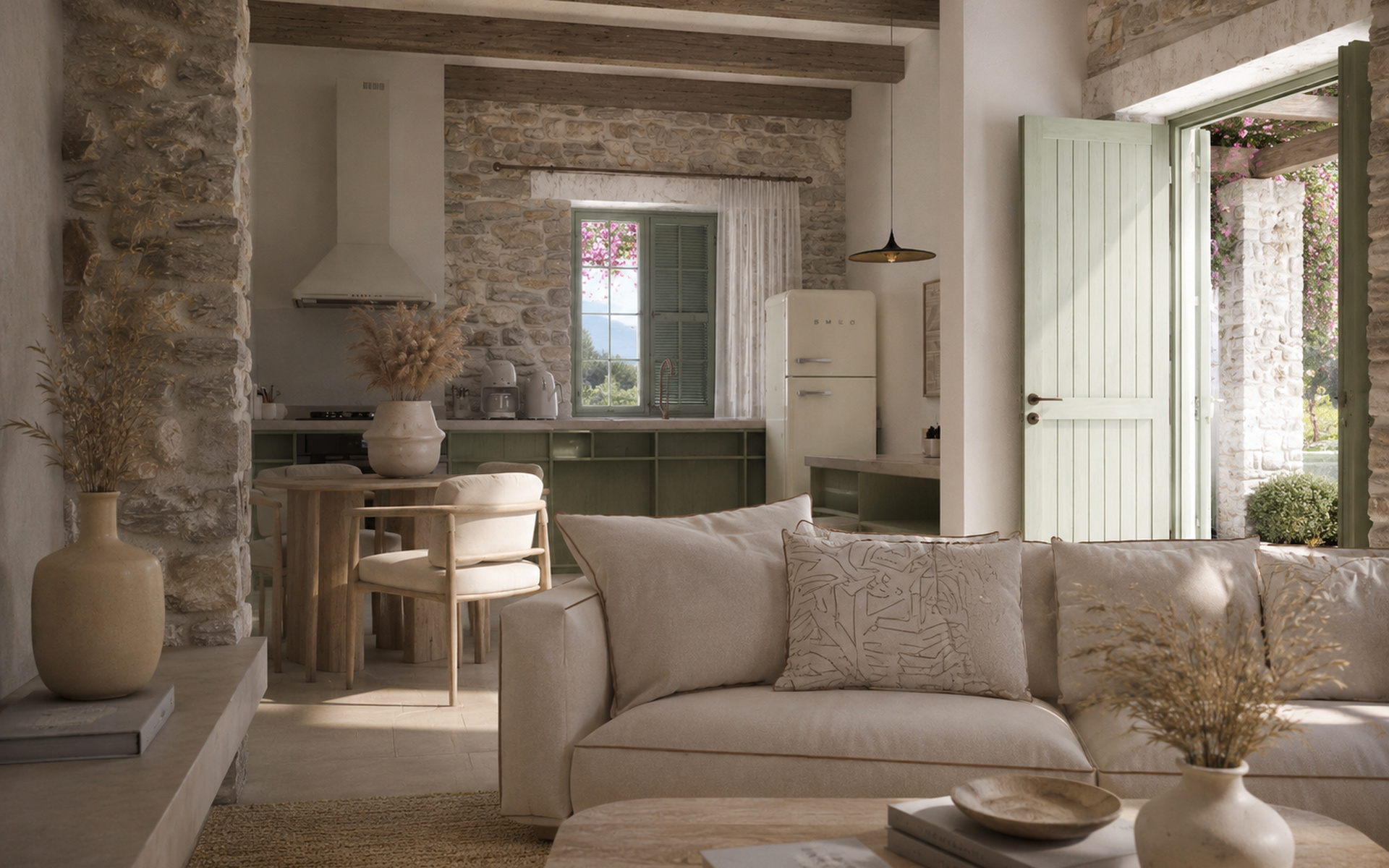
A smart home is often described by what it contains: connected controls, automated lighting, security systems, remote access, sensors and increasingly sophisticated technology.
But for a home that may not be occupied every day, there is a more useful definition of intelligence.
How easy is the home to own?
For a residence in Mani, particularly one used seasonally or shared between different places, smart living is not about filling every room with technology. It is about reducing the effort, uncertainty and unnecessary consumption involved in ownership.
Intelligence starts with the building
Before an app controls the temperature, the architecture has already made hundreds of decisions that affect how the home performs.
Orientation influences solar exposure. Shading protects interiors from excessive summer heat. Natural ventilation can reduce dependence on mechanical cooling when conditions allow. Insulation and an efficient building envelope help maintain more stable indoor temperatures.
Technology is most useful when it builds on these fundamentals rather than compensating for poor design.
This changes the hierarchy. The building does the passive work first. Systems then help monitor, control and optimise what remains.
Know what is happening when you are away
A second home creates a particular kind of concern: what is happening when nobody is there?
Remote monitoring and controls can make that relationship considerably simpler. Temperature, energy use and selected systems can be checked without physically being at the property. Lighting or climate settings can be adjusted before arrival. Problems can potentially be identified earlier rather than discovered weeks later.
The value is not the novelty of controlling something from a phone. It is the confidence of knowing that the home can remain manageable even when its owner is somewhere else.
Use resources when they are needed
Smart living should also mean avoiding unnecessary use.
Heating water when nobody is staying in the house makes little sense. Neither does cooling empty rooms simply because a system has been left running.
Better controls can help a residence respond to actual patterns of occupation. Combined with efficient equipment, water-conscious systems and the passive principles built into the architecture, technology becomes part of a wider approach to resource use.
Not more technology. Better judgement about when technology is necessary.
Convenience should disappear into the experience
The most successful systems are rarely the ones demanding constant attention.
They should make arriving easier, leaving simpler and everyday routines more intuitive. When technology becomes another complicated layer that needs managing, it has failed part of its purpose.
At ERAWA, smart living is approached in this broader sense: architecture, environmental performance and useful technology working together to make ownership simpler.
The smartest technology is the technology that gives you less to think about.
Because ultimately, a home in Mani should give its owner more time to experience where they are — not another system to manage.
Smart living at ERAWA is designed around effortless ownership.
Explore the residences and discover how thoughtful design supports everyday life in Mani.